
Jennifer Rauch
Purveyor of Fine Erudition in Journalism, Media & Communication
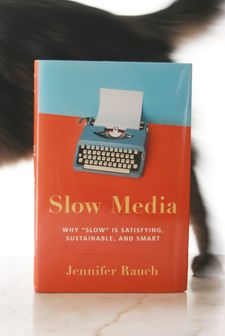
Cover of SLOW MEDIA

SLOW MEDIA

  • Finalist, Marshall McLuhan Book Award, Media Ecology Association
  • Winner, Krasnoff Memorial Award, LIU Brooklyn
  • Winner, Silver Nautilus Award, Environment/Sustainability

Why “Slow” is Satisfying, Sustainable, and Smart

Oxford University Press, 2018

One-Way Street, 2026 – Translation to Simplified Chinese forthcoming

Scrolling without reading. Clicking without thinking. Consuming without choosing. Information has never been more abundant, or less nourishing.

Many of us sense that something has gone wrong with our relationship to media — that the pace and volume of our connected lives is taking a toll on our attention, our communities, and our environment. Slow Media takes that feeling seriously and offers a framework for doing something about it.

Drawing inspiration from the Slow Food movement, I argue that the same values — humanism, simplicity, localism, and fairness — that transformed how we think about what we eat can transform how we think about what we read, watch, and share. Slow Media isn't about disconnecting entirely or retreating from modern life. It's about making more intentional, more satisfying choices about how we produce and consume media every day.

For anyone who has ever closed a tab, put down their phone, or longed for a quieter information environment, this book explains why that instinct is worth following.

Buy from Powell's Books or find it at Bookshop.org.

“In a landscape where infinite acceleration has become the default way of developing technology, doing business, and running an economy, Jennifer Rauch sees a growing number of people pushing back against the mandate to scale. Here is a compelling argument for why less is more, and how media can once again promote human existence more proportioned to human beings.”

— Douglas Rushkoff , Professor at CUNY Queens College; media theorist, best-selling author of "Team Human" and "Program or Be Programmed," and "one of the "world's 10 most influential intellectuals" (MIT)

“In this spirited, sane, and savvy manifesto, Jennifer Rauch shows us how to forge a better relationship with digital media. A book to be devoured — slowly.”
— Carl Honoré , BBC presenter and best-selling author of "In Praise of Slow: How a Worldwide Movement is Challenging the Cult of Speed"
Cover of THE ROUTLEDGE HANDBOOK OF ALTERNATIVE AND PARTICIPATORY JOURNALISM

THE ROUTLEDGE HANDBOOK OF ALTERNATIVE AND PARTICIPATORY JOURNALISM

Routledge, forthcoming

Edited by Jennifer Rauch and Stephen Cushion

The boundaries between alternative and mainstream journalism have never been harder to draw — or more important to understand. This handbook brings together leading scholars and emerging voices from around the world to take stock of what we know about alternative and participatory journalism, and to chart new directions for research in the 21st century.

Rather than settling on a single definition, the volume embraces the contested nature of the field as a productive starting point. Contributors examine the history and practice of alternative news production; questions of trust, accuracy, bias, and independence; the role of social media and streaming platforms in making and distributing alternative journalism; and the vital contributions of Black, indigenous, and other underrepresented communities to journalism's diversifying ecosystem. The handbook also looks beyond democratic contexts to consider how alternative journalism functions in authoritarian and hybrid political environments.

For students and researchers in journalism, communication, and media studies, The Routledge Handbook of Alternative & Participatory Journalism is both a comprehensive survey of existing research and an invitation to ask harder questions about the future of news.

Find it at Routledge.com.

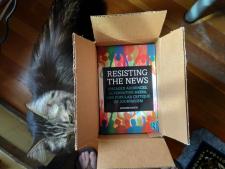
Cover of RESISTING THE NEWS

RESISTING THE NEWS

Engaged Audiences, Alternative Media & Popular Critique of Journalism

Routledge, 2021

What do people really think about the news — and why do so many choose alternative media?

Resisting the News brings together voices of activists and alternative-media users to offer a fresh perspective on the problems of journalism today and how ordinary people are already pushing back. Drawing on a 15-year research project, the book paints a layered portrait of how audiences filter their interpretations of mainstream news through the lens of their identities, values, and experiences with alternative media and political protest.

Rather than treating audiences as passive consumers of whatever journalists produce, this book takes seriously the critical skills, cultural resources, and creative strategies that real people use to make sense of their news environments — from the left and the right. The result is a richer, more human picture of how news actually works in people's lives.

Resisting the News will resonate with anyone curious about why trust in journalism has eroded, where alternative media fits into the picture, and what engaged, critical audiences look like up close. It is also an essential read for students and scholars of journalism, media studies, political communication, and cultural studies.

Buy it at Routledge.com.

“Jennifer Rauch has bestowed upon us a highly innovative and timely roadmap for understanding alternative media and their audiences. This deeply empirical and eminently readable book is perfect for students, researchers, activists, and anyone who dares to believe a better media system is possible.”

— Victor Pickard , Professor of media policy and political economy, Annenberg School for Communication, University of Pennsylvania; media author of "America's Battle for Democracy" and "Democracy Without Journalism?"

“News audiences tend to be talked at rather than talked with. But Jennifer Rauch has done the hard yards of seeking out and listening to those people who choose to consume alternative news media. The fascinating result blends empirical rigour with theoretical nuance, delivering insights of great value to scholars, journalists and citizens alike.”

— Tony Harcup , Emeritus fellow at Sheffield University; author of "Alternative Journalism, Alternative Voices" and "Journalism: Principles and Practice"